Book Importing Best Practices
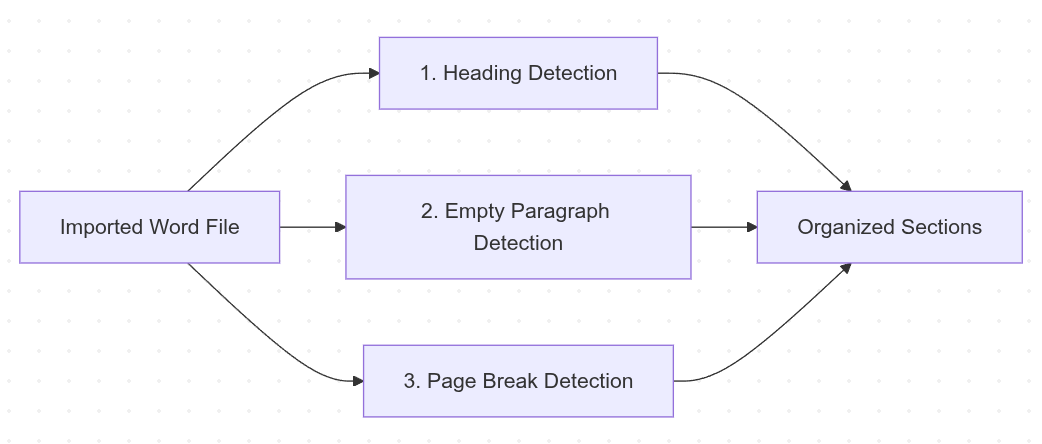
Want your manuscript to import perfectly with all sections (chapters, parts, front/back matter) automatically organized? These proven practices ensure flawless section detection and save you from post-import adjustments.
The key to perfect imports: Proper heading structure and clear section boundaries. Most documents work great as-is, but these quick improvements guarantee optimal results.
Quick Pre-Import Checklist
Review your document against this checklist before importing. Each item takes seconds to verify and prevents common section-splitting issues:
✅ Document Structure
- Save as
.docx- Ensure your file is in Word format - Use heading styles - Section titles formatted as Heading 1
- Subtitles - Immediately follow section titles with a Heading 2 for subtitles
- Consistent section naming - Use clear patterns like “Chapter 1”, “Chapter I”, or “Introduction”
- Clear section breaks - Adequate spacing or page breaks between major sections
✅ Section Organization
- One section per heading - Each major section starts with a Heading 1
- Logical flow - Front matter → Main sections → Back matter
- Standard section names - Use conventional terms (Introduction, Epilogue, etc.)
✅ Content Formatting
- Clean paragraph breaks - No excessive empty lines within sections
- Consistent spacing - Similar formatting throughout the document
- Remove extra elements - Delete complex tables or embedded objects if possible
Common Document Patterns That Work Perfectly
These examples show document structures that import flawlessly. Most well-written manuscripts already follow these patterns:
Example Structure
Title Page
Copyright
Dedication (optional)
Chapter 1
Chapter 2
Chapter 3
...
Epilogue
About the Author
Quick Fixes for Better Section Detection
If you want to optimize your document, these simple changes ensure perfect section recognition:
Section Headings (Most Important)
✅ Use these patterns:
Chapter 1
Chapter 2: The Quest Begins
Chapter One
Introduction
Epilogue
Conclusion❌ Avoid these patterns:
1. The First Chapter (numbers without a clear keyword like "Chapter" or "Section")
Part One - Beginning (embedded in larger text blocks)
CHAPTER ONE: THE STORY BEGINS... (overly long titles with excessive punctuation/caps)Section Separation
✅ Clear boundaries:
- Use page breaks between major sections
- Maintain consistent spacing between chapters
- Keep each chapter title on its own line
❌ Confusing boundaries:
- Chapter titles buried in paragraphs
- Inconsistent spacing throughout document
- Multiple chapters without clear separation
Document Organization
✅ Logical flow:
- Front matter sections at the beginning
- Main content (sections/chapters) in the middle
- Back matter sections at the end
- Consistent naming conventions
How Subtitles Work
Subtitles let you present a short descriptor under the main section title. The importer pairs a Heading 1 (title) immediately followed by a Heading 2 (subtitle).
What to do
- Use Heading 1 for the section title
- On the very next line, add Heading 2 for the subtitle (ideally, have no body text in between)
Also supported
- A single Heading 1 like “Chapter 2: The Quest Begins” may be split into title + subtitle automatically in many cases.
- Scrivener users: if Heading 2 subtitles aren’t importing as expected, use a single Heading 1 formatted like
Chapter 1: Subtitle. See the note above.
Section Types Lacuna Recognizes
Lacuna automatically detects and categorizes these common book sections:
Front Matter
- Title Page, Copyright, Dedication
- Acknowledgments, Foreword, Preface
- Introduction, Table of Contents
Main Content
- Chapter (numbered or named)
- Part, Section (for multi-part books)
Back Matter
- Epilogue, Conclusion, Afterword
- Appendix, Glossary, Bibliography
- About the Author, Index
When Things Don’t Import as Expected
Most documents import perfectly, but if your sections aren’t detected correctly:
Before Re-importing
- Check your headings - Ensure section titles use heading styles (not just bold text)
- Verify section names - Use standard terms like “Chapter 1” or “Introduction”
- Review spacing - Add clear breaks between major sections
- Simplify titles - Keep section headings concise and standalone
After Import
Don’t worry! Even if sections aren’t perfect initially:
- Easy reorganization - Drag and drop sections in the editor sidebar
- Quick renaming - Click any section title to edit it
- Flexible structure - Add, remove, or rearrange sections as needed
Ready to Import?
Your manuscript is ready! Head to How to Import Your Manuscript to transform your document into a beautiful book project.
After Import, Explore:
- Arranging Your Sections - Fine-tune your book’s structure
- Working with Section & Chapter Headings - Formatting options for titles and headings
- Choosing Your Style - Professional styling for your book